3.4.2 One⁃strut failure analysis:two hypothetical ...
In order to investigate the influence of the one⁃strut failure on the adjacent struts,the strut forces before and after strut failure are examined.By tabulating the load transfer percentage,the influence of the strut failure can be demonstrated.Assume Npre is the load on the strut before strut failure;Npost is the load on the strut after strut failure and Nfail is the load on the failed strut before failure.Then the load transfer percentage is defined as Eq.3.10.

1)One⁃Strut Failure for Soft Clay:He=12 m with 3⁃Levels of Struts
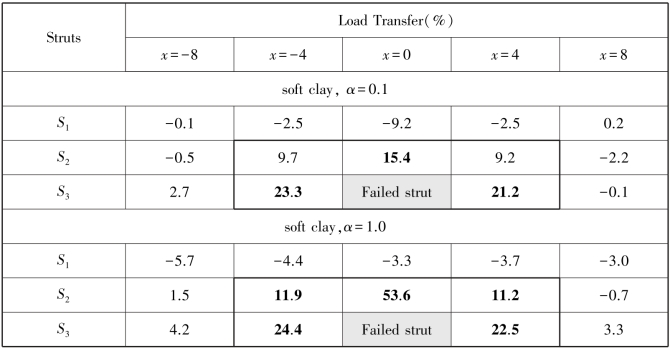
The load transfer percentages from 2D analyses are tabulated in Table 3.7,and the 3D results are shown in Table 3.8.The 2D results indicate that failure of S3 leads to considerable increase in the load for the 2nd level S2 strut.On the other hand,the 3D results indicate that the load of the failed strut is not only transferred vertically upward,but also to the adjacent horizontal and diagonal struts as shown in Figure 3.16,where larger arrows denote the larger magnitude of the transferred loads and the red circles denote the struts with more than 10% load increase after the one⁃strut failure.It should be noted from Table 3.8 that the load transfer percentage values along the left and right sides of the failed strut(i.e.,9.7 and 9.2 for soft clay,a=0.1,S2 in Table 3.8,23.3 and 21.1 for soft clay,a=0.1,S3 in Table 3.8)are not equal considering that the numerical model is not symmetrical about the failed(x=0)strut.In addition,for the 3D analyses,the magnitude of the load transfer percentages is much smaller,up to approximately 20% for flexible walls and 50%for medium walls compared with the results from the 2D analyses.Therefore,compared to 3D results,the 2D analyses overestimate the possible consequence of the one⁃strut failure for soft clay,as it ignores the restraining effects of the adjacent horizontal struts.
Table 3.7 Load transfer percentages from 2D analyses for the one⁃strut failure of S3(soft clay)
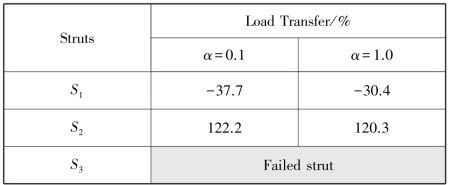
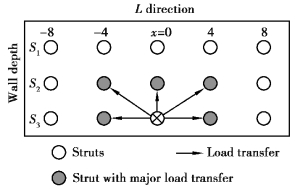
Figure 3.16 Influence zone of the one⁃strut failure of S3(soft clay)
Table 3.8 Load transfer percentage from 3D analyses for the one⁃strut failure of S3(L/B=2.2)
2)One⁃Strut Failure for Medium and Stiff Clays:He=16 m with 5⁃Levels of Struts
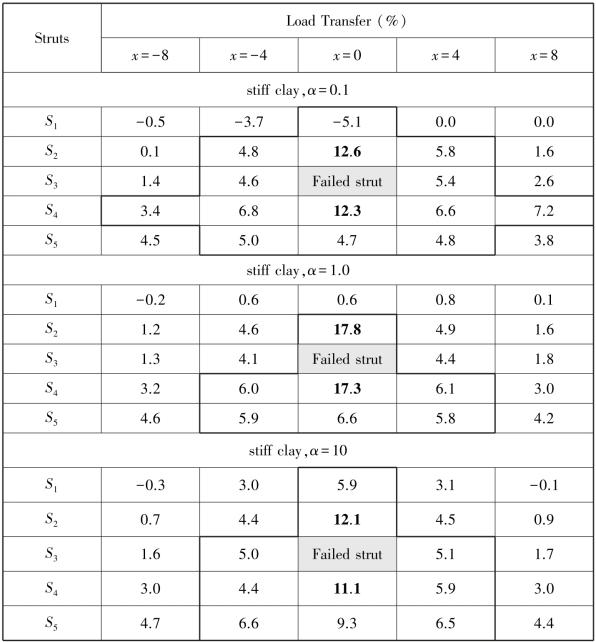
The load transfer percentages of the one⁃strut failure from 2D analyses for medium and stiff walls are shown in Table 3.9.For medium clay,most of the load of the failed strut is transferred to the struts immediately above and below the failed strut,with approximately 30% to 50% of the load transferred to the upper strut and the remainder carried by the lower strut.For stiff clay,the failure of strut S3 leads to the force redistribution for the S2,S4 and S5 struts.The S2 and S4 struts each carry approximately 30% of the load of the failed strut,and S5 carries approximately 10% to 20%.When the wall is also stiff,the top strut is able to carry approximately 10% of the load.For the 3D analyses,the percentage of the load transfer to adjacent struts of the relevant struts for medium clay with stiff walls are tabulated in Table 3.10 for L/B=2.2 and Table 3.11 for L/B=3.4,respectively.The tables show that the struts affected most are located directly above or below the failed strut S4 or diagonally across,as plotted in Figure 3.17.The influence of the one⁃strut failure from 3D analyses for the stiff clay is shown in Figure 3.17.The load transfer percentages for stiff clay is listed in Table 3.12 for L/B=3.4.The load is mainly transferred to the struts directly above and below the failed strut S3,and the load transfer percentage is approximately 10% to 20%.The 3D results again highlight that the 2D analyses would result in fairly conservative(i.e.larger)estimates of the loads transferred to the adjacent struts from the failed strut as it ignores the restraining effects of the adjacent horizontal struts.
Table 3.9 Load transfer percentage from 2D analyses(medium and stiff clays)
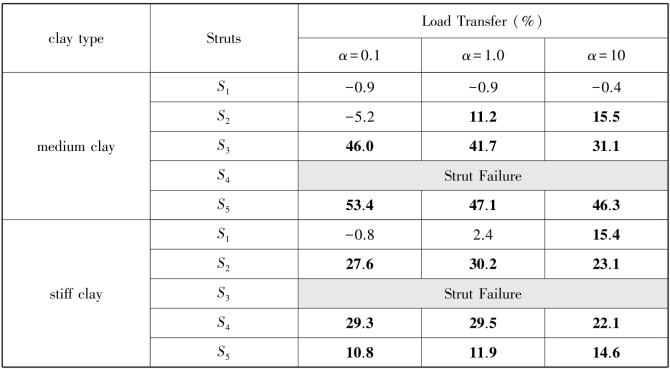
Table 3.10 Load transfer percentage from 3D analyses for the one⁃strut failure of S4 for medium clay(L/B=2.2)
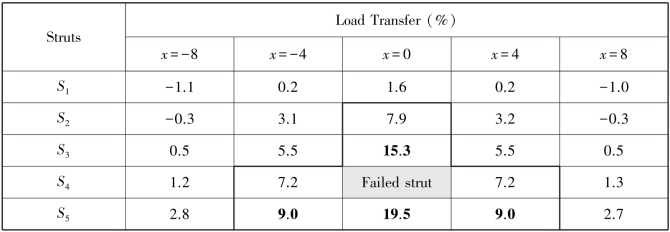
Table 3.11 Load transfer percentage from 3D analyses for the one⁃strut failure of S4 for medium clay(L/B=3.4)
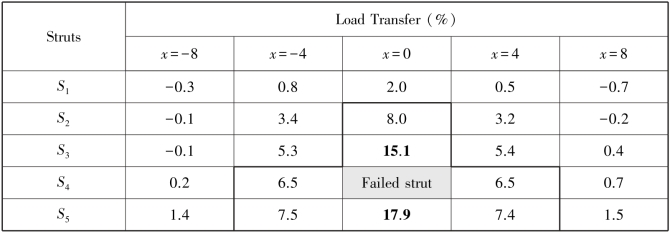
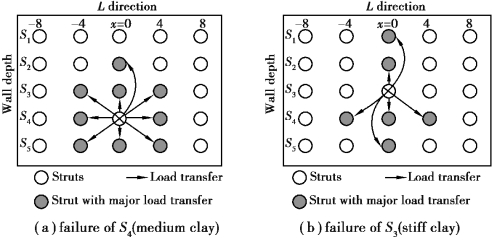
Figure 3.17 Influence zone of the failure of strut
Table 3.12 Load transfer percentage from 3D analyses for the one⁃strut failure of S3 for stiff clay(L/B=3.4)