12.3.2 Genetic algorithm
The gradient method the uniqueness of the solution of the inverse problem,however,modelling errors or in situ measurement uncertainties are not sufficiently taken into account by inverse analysis processes to be sure about solution accuracy.There is not one unique and exact solution but rather an infinity of approximate solutions around an optimum.The aim of the parameter identification should better be the identification of this infinity of approximate solutions rather than the one with the lower error function whose definition is arbitrary.
The genetic algorithm(GA)is robust and highly efficient method,which is able to solve complex optimization problems,but does not guarantee an exact identification of the optimum solution.However,it does permit the localization of an optimum set of solutions close to this optimum.
Genetic algorithm is an optimization method inspired by Darwin's theory of evolution.It is a well⁃known method to optimize an objective function with linear or non⁃linear constraints.
Genetic algorithm is a stochastic global search technique,which does not need a derivative evaluation of the error function.It is recognized to be highly efficient in dealing with large,discrete,non⁃linear and poorly understood optimization problems.This method does not guarantee the exact identification of the optimum solution of a problem.But genetic mechanisms,such as reproductions,crossings and mutations,permit to localize an optimum set of solutions close to the optimum in a given search space.It uses stochastic processes to produce an initial population of models,in similar fashion to random Monte Carlo simulation,and simple manipulations or operators are applied to the model population.The result of applying the operators to a model population is to produce a new population of models,constituting an iteration.This process is repeated for a number of times until a suitable model or group of models evolves.
Each set of Np unknown parameters is noted as a vector p.The minimization problem is also solved in the Np⁃dimension space restricted to authorized values of p between pmin and pmax which define the search space.The brief principles of the minimization algorithm can be summarized as follows:
(1)Encoding,individual and population
Each mechanical parameter is binary encoded and represents a gene.The concatenation of several genes forms an individual.Each individual defines a point of the search space.A group of Ni individuals represents a population of the ith generation.
(2)Generation of an initial population
Group of Ni individuals is randomly chosen in the search space.The scalar error function for each individual of a population is evaluated.Mechanisms of selection,reproduction,and mutation are used to make the population evolve to the best individuals in the search space.
(3)Selection
Depending on their fitness(minimal cost of scalar error function),only the best Ni/3 individuals are preserved for the constitution of the next population.They are called parents.This‘elitist’selection is known to be more efficient for unimodal function optimizations.
(4)Reproduction and crossing
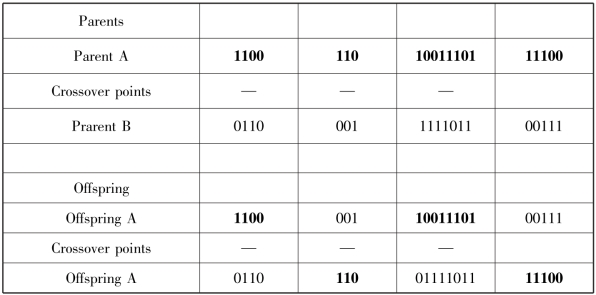
The parents are randomly selected by pairs and crossed over into Ncoup points to generate new pairs of offsprings(Table 12.2).To improve the algorithm efficiency,the Ncoup number is chosen equal to the number of sought parameters.Crossing process is repeated until 2Ni/3 offspring are created.These new offspring are called children.
Table 12.2 Illustration of the reproduction between a pair of parents to generate a new pair of offspring in genetic algorithm optimization method
(5)Mutation and generation of a new population
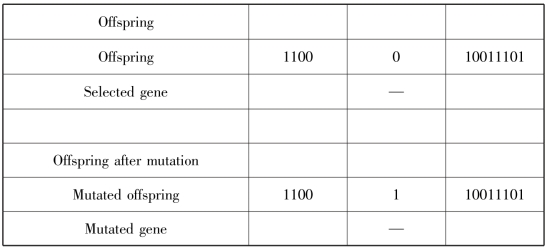
Putting together parents and children create a new population of Ni individuals.To limit the convergence problems and to diversify the population,some of the individuals are randomly mutated(Table 12.3).
(6)Test of convergence
The three previous stages are repeated until the error function average(or standard deviation)of the parent part of the population is less than a given error.
Table 12.3 Illustration of the mutation of an individual in genetic algorithm optimization method