
4.3.1 Simplified methods
Generally speaking,simplified methods employ the monitoring results of excavation case histories and then sort them into the stress and deformation characteristics of retaining walls and soils.The characteristics are useful not only to help understand the actual excavation behavior but to offer information for excavation⁃induced stress and deformation analyses.
The strut⁃retaining system of an excavation is,in nature,a highly static indeterminate structure and thereby is difficult to analyze by hand calculation unless the loading pattern,boundary conditions,and analysis method are simplified.The stress analysis methods that will be introduced in this chapter are induced from accumulated experience or observations of designers and are more applicable to common excavations.As for special excavations(e.g.large scale or great depth),the numerical method introduced in the next part,is recommended instead,considering that the simplified method is lacking in solid theoretical support.
For cantilevered walls,the design of a cantilevered wall is based on the fixed earth support method,that is,the embedded part of the wall is assumed to be fixed at a certain depth.Thus,in the limiting state,the active earth pressure above the excavation surface can develop fully;whereas the passive and active earth pressures near the fixed point cannot.On the other hand,under working load,though the active earth pressure above the excavation surface may still fully develop,the passive as well as the active earth pressures near the fixed point are not fully developed.It is therefore difficult to estimate the distribution of earth pressure on the retaining wall.To be conservative and simplify the procedure of computing the stress of cantilevered walls,we may assume the earth pressure is in the limiting state.
With the earth pressure on the wall known,we can then adopt the simplified gross pressure method for the analysis of the stress of a cantilevered wall(Padfield and Mair,1984),as shown in Figure 4.12(a).The earth pressure distribution must not include the safety factors,or the distribution of earth pressures will be distorted.Though the depth of the wall used for analysis,as shown in Figure 4.12(a),is not as great as designed[Figure 4.12(b)],the maximum bending moment of the wall thus derived is the closest to the real value,as shown in Figure 4.12(b).If sheet piles or soldier piles are to be adopted,we can design according to the maximum bending moment without knowing the distribution of bending moments.If the retaining wall is an RC wall(such as diaphragm walls or column piles),the bending moment derived from the simplified method has to be modified.For a cantilevered wall,the real distribution of earth pressures under working load is difficult to obtain.To be conservative and simplify the calculation,the earth pressure in the limiting state can be adopted for the stress analysis of a cantilevered wall.Both the gross pressure method and the net pressure method are applicable to compute shear and bending
moment of a cantilevered wall.
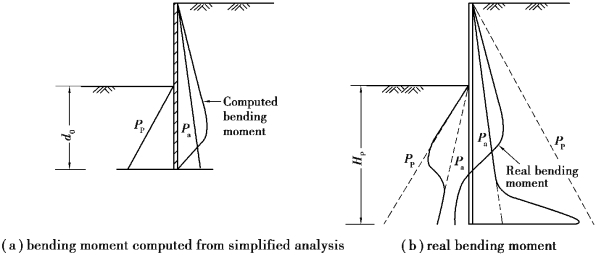
Figure 4.12 Computation of bending moment of cantilever walls
The simplified methods are mostly empirical formulas or diagrams based on the monitoring results of excavations.Since an excavation can be viewed as a full scale test,with similar geological conditions and excavation methods,simplified methods based on past experience are feasible to make reasonable predictions.