
5.2.1 Wall installation
The construction of a diaphragm wall first partitions the wall into several panels.The construction process of each panel includes guided trench excavation,guided wall construction,trench excavation(for diaphragm wall),and reinforcement placement and concrete casting,the depth of a guided trench is generally about 2⁃3 m,sometimes 5 m.Before concreting guided walls,guided trenches,not strutted,are open ditches.The maximum settlement induced by excavation of the guided trench occurs at the verge of the trench.The settlement decreases with the distance from the trench.Considering that both measurement of and literature on this field are almost nonexistent and that no significant settlement occurs during this stage(Woo,1992),this chapter will not delve into the subject.
The stress condition of soil in the vicinity of trenches during diaphragm wall construction is rather complicated.Take the construction of a single panel of a diaphragm wall for example.To keep the trench wall from falling,it is necessary to fill the panel with stabilizing fluid during the excavation process of the trench panel.Under normal construction conditions,excavating a trench panel filled with bentonite will cause the stress state of the soil around the trench panel to change from the original K0 to the balanced state of the fluid pressure.However,the fluid pressure is normally not equal to the original earth and water pressures in the trench panel,but is usually smaller.The trench excavation will decrease the total lateral stress of the soil within a specific range around the trench,and thereby produce lateral movement of the soil in the vicinity of the trench.Ground settlement is thus produced.During concrete casting,the lateral pressure in the panel during this stage should be greater than the fluid pressure during the stage of excavation because the unit weight of concrete is greater than that of stabilizing fluid.Therefore,the lateral movement caused at the previous stage will be pushed back and decrease in amount while the amount of ground settlement does not change significantly.
The soil deformation behavior caused by trench excavation is not the same as that caused by main excavation.The reasons for the differences are the differences in excavation geometric shapes and the strutting methods.The ratio of the depth of a trench panel to its width and that of the depth to length are both much larger than those in main excavations.What's more,there is the influence of stabilizing fluid employed to counteract the lateral earth pressure and to ensure the stability of trench walls.Nevertheless,in spite of the differences in geometric shapes and construction techniques,the excavation of a trench panel is also a type which can produce deformations,though few and with small influence range.The shape of ground surface settlement is basically similar to that induced by main excavation.
Besides,because the retaining wall is the combined whole of many connected diaphragm wall panels,settlement will be accumulated panel by panel and the final deformation gets more serious accordingly.Though the problems of ground displacement induced by the construction of diaphragm walls have gradually drawn attention from engineers,there are few study results available due to the complexity of the construction process and the fact that monitoring results are almost nonexistent.In the 1980s,there were some in situ monitoring projects and some results were obtained.Nevertheless,most of them were confined to the deformation induced by the construction process of a single panel;for example,those carried out in Oslo and in Singapore.As for the monitoring of the final deformation after the completion of a whole retaining wall,there is almost no literature.According to the monitoring results of the rapid transit system in Hong Kong(Cowland and Thorley,1985),after the completion of the diaphragm walls and before the main excavation,the accumulated deformation can be 40%⁃50% of the total deformation after the completion of the main excavation.Clough and O’Rourke(1990)found that the ratio of the maximum settlement induced by the construction of diaphragm walls to the depth of the trench is 0.15%,according to many in situ monitoring results,as shown in Figure 5.2.We can see that soil settlement in the vicinity of diaphragm wall panels,induced by their construction,is significant and that caution is strictly required to protect adjacent properties.
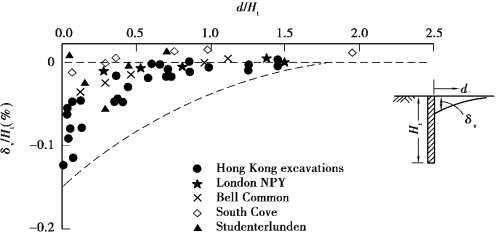
Figure 5.2 Envelope of ground surface settlements induced by trench excavations(Clough and O’Rourke,1990)